Typing first
Your specific HPV types are identified: the method works not “against the virus in general” but against the types found in you.
 MedBridgeBoao Lecheng · Hainan, China
Cellular medicine · immunity
If high-risk HPV doesn't clear on its own, there is a targeted immune-cell approach: your cells are activated against the identified virus types and returned to the body. It all starts with diagnostics and typing. The method does not replace screening, vaccination and standard treatment — a physician determines whether it's appropriate.
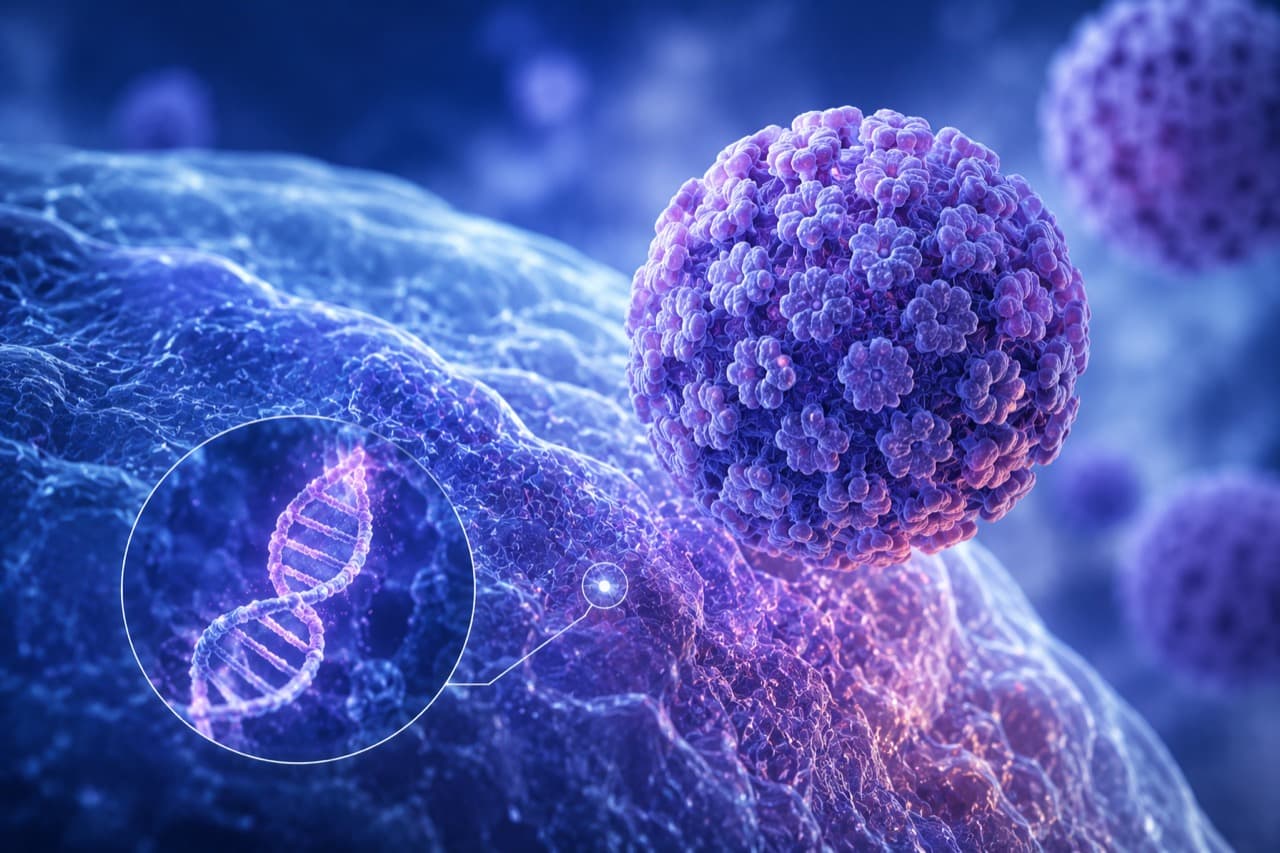
About the method
HPV (human papillomavirus) has more than 200 types. Low-risk types (6, 11) are linked to genital warts; persistent infection with high-risk types (16, 18, 31, 33, 45, 52, 58 and others) is a risk factor for precancerous changes of the cervix. The link between HPV and cervical cancer was established in the work of Harald zur Hausen (Nobel Prize 2008).
The method uses the patient's own immune cells: they are “trained” by loading them with antigens of the HPV types identified in you (from typing results), then returned to support a targeted immune response against infected cells and to regulate the immune environment. In China this belongs to third-category medical technologies (since 2009 cell therapy has been included in the relevant register of the National Health Commission).
The approach is always accompanied by diagnostics (a “three-step” model: cytology and HPV typing → colposcopy → biopsy if needed) and does not replace regular screening and vaccination.
How it works
Your specific HPV types are identified: the method works not “against the virus in general” but against the types found in you.
Immune cells from your blood are loaded with antigens of those types — like a “photofit” of the target that makes it easier for your immunity to recognise it.
The prepared cells are returned to support a targeted immune response against the infected cells.
The method runs alongside screening (cytology, colposcopy) and does not replace vaccination — the physician directs the strategy.
Scientific basis
Facts about the method's origin, standards and quality control — what trust is built on. This is not a promise of a result: a physician decides whether it's right for you.
The method is based on dendritic cells (DC) — the “mentors” that show the immune system which target to attack.
The approach of loading antigens onto DCs and activating an immune response is studied in immunotherapy; protocols are individual.
The field of cellular immune technologies was granted third-category status in China (2009).
Status and evidence
Where other clinics print success rates, we print the regulatory status, the level of evidence and what that means for your expectations. Whether the method is used in your case is decided by the hospital's physician.
Cell immunotherapy for persistent HPV is used in the cluster under the zone's permit — after typing, cytology and, where indicated, colposcopy.
No product for treating an existing HPV infection is registered in any country: therapeutic vaccines and cell-based approaches are in clinical trials. Preventive vaccines protect against infection but do not treat persistence.
Early-phase data: viral clearance in a proportion of patients, without large controlled trials. The standard of care remains regular screening and treatment of dysplasia (excision, conisation) — which the method does not replace.
The method is considered for multi-year persistence of high-risk types when observation has not helped. The effect is individual, with a check at 3–6 months; the decision rests with the physician after examination.
The team
Examples of the specialist physicians we work with in this area. The cluster holds several hospitals — the clinic and the specialist are matched to your case. Physicians prescribe and deliver the treatment; MedBridge coordinates the route.
 Luo ZhihuaInternal medicine · cellular technologies
A graduate of the University of Science and Technology of China (USTC). Internal medicine, 10+ years in practice; experience with stem cells, NK and CIK. Named “Best Doctor” of the Boao Lecheng zone (2019).
Who it's for
Most people who consider this method recognise themselves in situations like these. It's not a prompt for self-treatment — whether it fits your case is decided by a physician after consultation and diagnostics.
The virus isn't clearing on its own, and you want a concrete plan and oversight.
You want to address a sensitive matter confidentially and at a high level.
You prefer virus typing and a precise strategy matched to the result.
You're considering an additional method within standard care — by the physician's decision.
You need diagnostics, interpreting and support in one place, without chaos.
The moment
Years of “watch and wait” wear you down more than the infection itself. If you are tired of waiting for the virus to “clear on its own” — you now know a targeted tool exists and is within reach. Whether it fits your case, a physician determines after typing. Confidential — from the first message to the result.
Why patients consider it
These are reasons for interest in the method, not a promise of outcome: the physician sets the final decision and realistic expectations.
Cells are activated against the HPV types identified in you — the approach is built on typing results.
Your own immune cells are used; in China the method belongs to third-category medical technologies.
A three-step model: cytology and typing → colposcopy → biopsy if needed. The method does not replace screening and vaccination.
In most countries, persistent HPV means one thing — watch and wait. Here there is a targeted cellular tool: in the zone's certified clinics, confidentially and strictly by indication.
Indications
May be considered by a physician for persistent HPV infection. This does not replace screening and vaccination; a specialist determines suitability.
Cost
Approx. ¥148,000 (≈ $20,600)
Your immune cells are “trained” with antigens of your specific HPV types and cultured for about three weeks.
Typing, cytology and colposcopy by indication — the method doesn't begin without them.
Targeted local administrations by the physician's protocol and a re-examination at 3–6 months.
The exact cost is determined only after diagnostics — the programme is tailored individually, by indication. Payment is made directly to the cluster's clinic, by official invoice. For context: cells into the knee here cost ¥36,000 (≈ $5,000) per injection at the zone's registered price, against $35,000–50,000 in Western European clinics; a systemic infusion here is from ¥50,000 (≈ $6,950), against $20,000–22,000 in Japan and Switzerland. All prices → · Zone registry → · Country comparison →
Safety
The approach is built around patient safety and verifiable quality.
Process
Cytology, HPV typing, colposcopy by indication.
The patient's venous blood (about 150–160 ml) to isolate and “train” the cells.
Cells are loaded with antigens of the identified HPV types and cultured for about 3 weeks.
Targeted local administrations; a course usually involves several procedures at short intervals — by the physician's protocol.
Review and re-examination in 3–6 months.
The physician determines the plan and realistic expectations. The method does not guarantee a result and does not replace screening, vaccination and standard treatment.
Plus Chinese medicine
A cell technology works on the tissue; pain, sleep, recovery and routine between courses are the work of Traditional Chinese Medicine. In the cluster the two can be combined in one plan on one trip — in mainland China, only here. The combination is prescribed by the physician after the work-up.
A 7-day TCM course is from ¥4,100 in procedures. How they are combined → · TCM programmes →
Outcomes
The immune response forms gradually; review and re-examination at 3–6 months.
Dynamics are tracked by repeat HPV typing, cytology and, by indication, colposcopy.
Support for your own immune response against the HPV types identified — not a replacement for screening, vaccination and standard treatment.
The method does not guarantee clearance of the virus and is not a treatment for oncological disease; the physician determines strategy.
Safety
Openness about safety is part of a responsible approach.
Your own immune cells are used, not donor material — immunological risks are minimal.
HPV typing, cytology and, if needed, colposcopy — the method does not start without them.
Moderate local reactions are possible; serious reactions are rare. Individual tolerability is assessed by the physician.
Contraindications usually considered include pregnancy, active concurrent infections and others. The method does not replace screening and vaccination; the physician decides.
Safety
The method runs not instead of but alongside serious diagnostics: typing, cytology and colposcopy if needed — and it does not replace screening or vaccination. Your own immune cells are prepared to GMP / ISO standards in the zone's certified clinics; in China this field holds official third-category medical-technology status. Everything is strictly confidential, from the first message to the result. After the course — a re-examination at 3–6 months and a coordinator in touch, including by telemedicine.
Every programme begins with a consultation and an accurate diagnosis (check-up). Treatment does not start without assessing indications and contraindications.
Questions
Yes. Every programme begins with a consultation and diagnostics (check-up). No therapy starts without an accurate diagnosis and assessment of contraindications — that is the basis of safety.
No. The method does not replace HPV vaccination and regular cervical screening — they remain the basis of prevention.
No. It is not a treatment for oncological disease and not a guarantee of its prevention. The physician determines strategy after diagnostics.
From the patient's own blood; the cells are activated against the HPV types identified at typing.
The active part is a few days (diagnostics, blood draw, administrations by protocol); follow-up at 3–6 months can be done locally. Exact timing is agreed in advance.
No. The method does not replace standard care for identified cervical changes; the decision to treat is made by the physician.
The volume of diagnostics and the programme. See the Pricing page for a guide; the exact estimate is formed after diagnostics and paid directly to the clinic.
Tell us your situation and medical goal — we'll advise which documents help prepare a preliminary review and what the next steps could be.