
Journal
A living Taoist lineage: what it is and why seeing a bearer is rare
In China the Taoist tradition and medicine walked side by side for centuries, yet few bearers of living lineages remain — and almost all are beyond an international patient's reach. What a transmission is, why it is a mark of quality, and how a consultation with Master Zhi Ning works.
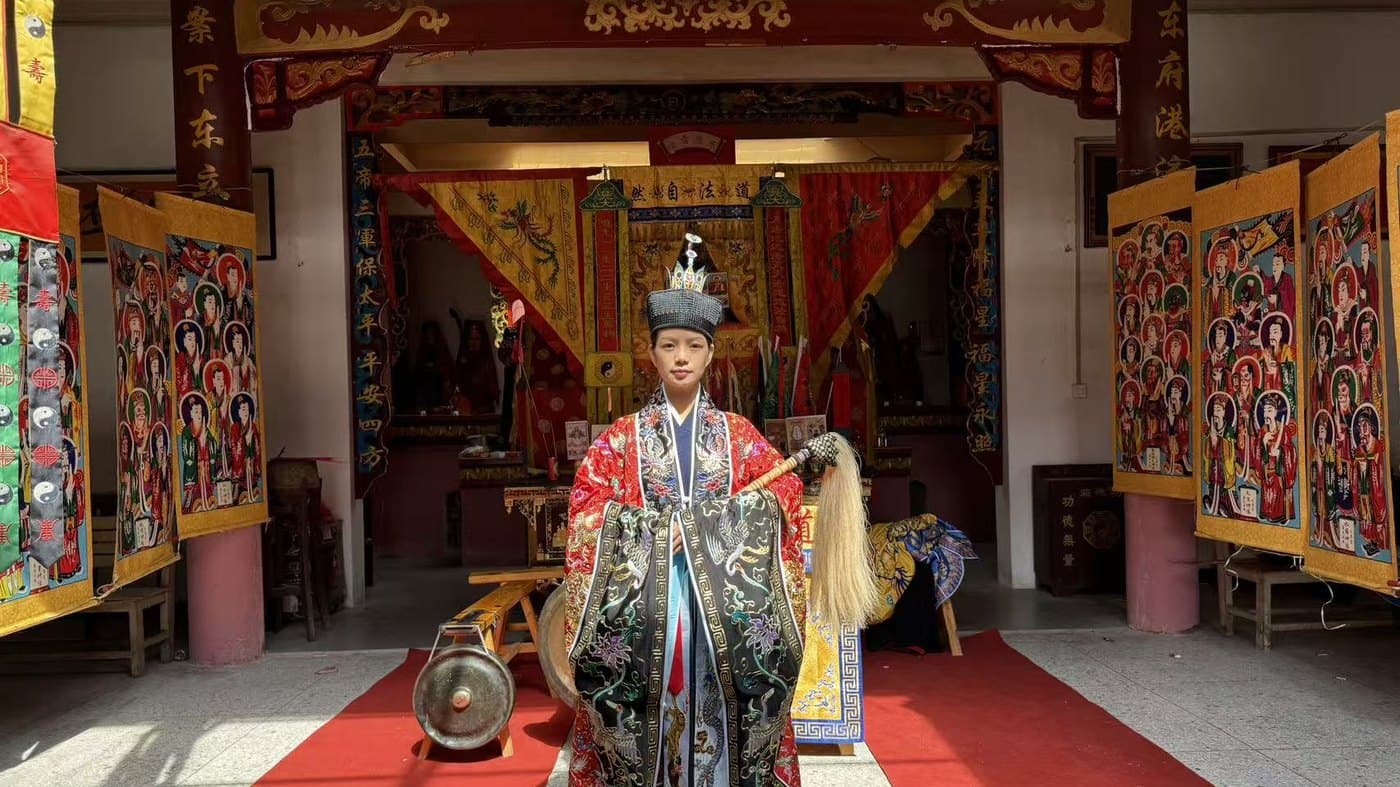
The words 'Taoist master' on a medical platform may raise a question: is this about medicine at all? The answer is yes — more than it may seem: the Taoist tradition is the elder root of Chinese medicine, and the line of transmission is that culture's strictest mechanism of quality control over knowledge.
Below: what a living transmission is, how it differs from 'courses in Eastern practices', why bearers are few, and how a consultation with Master Zhi Ning — a bearer of two Taoist lines and successor of the Li Ke medical school — is arranged.
What a line of transmission is
In the Taoist tradition, knowledge is not published — it is passed personally, master to student, and every transmission is recorded: school, generation, name. When a master is described as 'the Shangqing school in the 80th generation', that is not a poetic phrase but a place in a specific recorded line, which can be named and verified within the tradition.
This is why a transmission is a mark of quality that cannot be bought. Diplomas are issued by organisations; a place in a line is granted only by a mentor, who answers for the student with their own reputation before the whole school.
- Shangqing (Maoshan) — one of China's oldest Taoist schools, of Mount Maoshan
- Zhengyi Qingwei — a line with the ritual 'thunder practices' tradition
- Generation — a recorded place in the chain of transmission, not seniority or a title
Taoism and medicine share one root
The basic concepts of Chinese medicine — qi, yin and yang, the unity of body and spirit — came from the Taoist picture of the world, and for centuries Taoist mentors were also physicians. The strictest medical branch of this tradition is the jingfang school, 'classical formulas': Han-era prescriptions, above all the 'Shang Han Lun' of Zhang Zhongjing, whom China calls the 'sage of medicine'.
Its living continuation is the academic school of Li Ke (1930–2013), the famed Shanxi physician renowned for applying classical decoctions in severe conditions in Chinese hospital settings. Master Zhi Ning is this school's successor in the third generation — which makes her case especially rare: two Taoist lines and a strict medical school in one person.
Why seeing a bearer is rare
Bearers of living lineages with medical training are few even in China: transmission is by nature singular. Add the barriers that are nearly insurmountable for a foreigner: the language, the tradition's reserve, and the absence of 'walk-in appointments' — such masters are usually reached only through personal recommendation.
In the Boao Lecheng cluster this door is open: the master consults beside modern diagnostics, appointments are arranged in advance, with an interpreter, and the whole route is led by a coordinator. The number of patients is limited — this is a format of personal work, not a flow.
Who it suits — honest boundaries
A consultation with the master is a medical conversation with prescriptions: classical formulas, pulse diagnosis, restorative practices, dietetics. The format involves no religious obligations — the Taoist school is the source of the method, not a rite for the patient.
People come most often with complex chronic conditions — as a complement to their main treatment: a cardiac history, autoimmune conditions, persistent insomnia, women's health, recovery after chemo- and radiotherapy. The programmes do not replace standard care, and in acute conditions the only right route is emergency medicine. It is sensible to pair the consultation with a check-up: the master will see both the classical and the modern picture.
Questions
Frequently asked questions
No. The consultation is a medical conversation with prescriptions: formulas, practices, regimen. The line of transmission is the master's level of training, not a rite the patient takes part in.
Yes — prescriptions are built as a complement, and nothing in your treatment is cancelled. The master studies your records and medication list in advance; decisions on base therapy remain with your treating physician.
Through a coordinator, by prior arrangement: the master sees a limited number of patients. Write to us — we will tell you about upcoming availability and the documents worth preparing.
Read next
Useful on this topic
Discuss your situation with a coordinator
Describe your medical goal — we'll advise which documents are needed for a preliminary assessment and what the next steps could be.