Needle-knife — precise tissue work
A micro-instrument releases chronically contracted areas — what needle and hands cannot manage.
 MedBridgeBoao Lecheng · Hainan, China
TCM · Specialised techniques
Fine medical techniques at the meeting point of the classical needle and the minor procedure. They are never done 'on request' — only by strict indication, after in-person diagnosis, in the hands of experienced specialists. It is techniques like these that set a deep school apart from 'acupuncture by the book'.
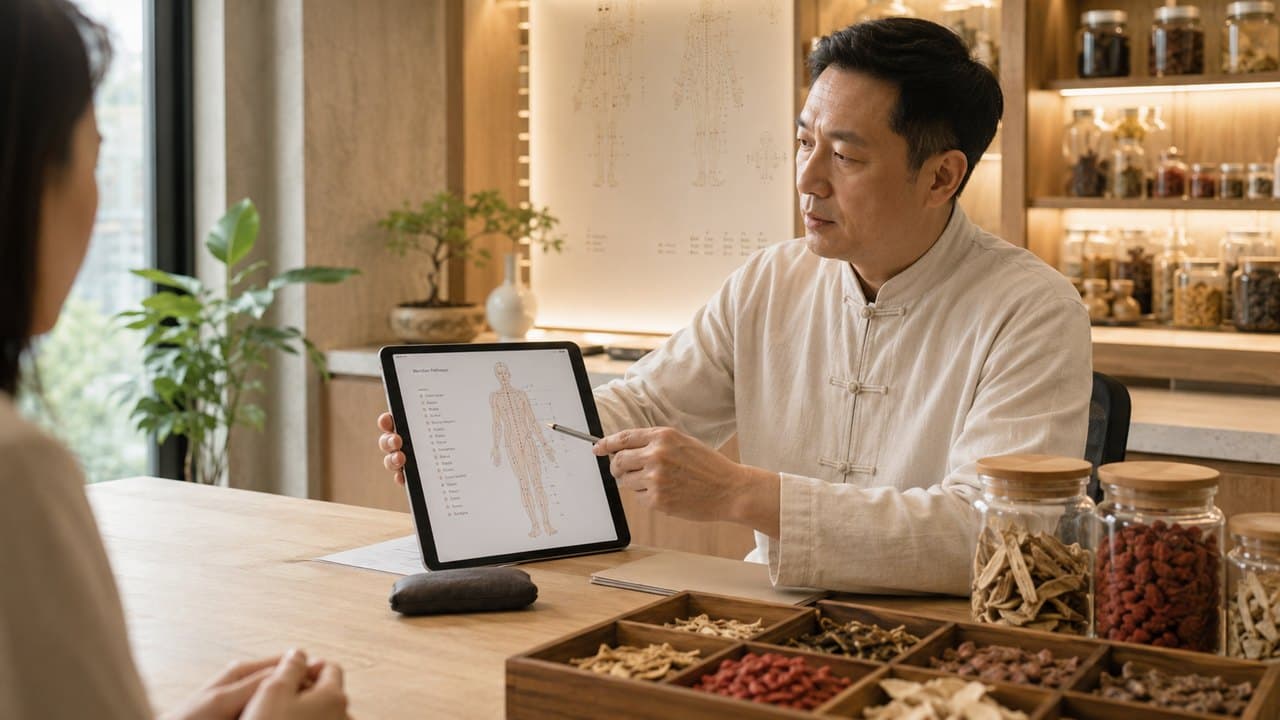
About the method
The classical needle has its 'senior' techniques — for situations where an ordinary session cannot reach the needed effect. In China they are practised by physicians with special training; outside the country such specialists are rare. This is one reason people travel to the source for deep TCM.
The needle-knife (小针刀) is an instrument as thin as a needle with a microscopic flat tip. It lets the physician work point-precisely with dense, chronically contracted areas of tissue that the ordinary needle cannot reach. The procedure is short and targeted.
Pharmacopuncture is the micro-injection of preparations into biologically active points: the point amplifies the preparation, the preparation amplifies the point. The composition and doses are set by the physician, by indication.
Thread embedding (catgut therapy) places the finest absorbable thread into a point. While the thread dissolves (weeks), the point receives gentle continuous stimulation — 'a session that continues between visits'. Convenient for those who cannot come often.
How it works
A micro-instrument releases chronically contracted areas — what needle and hands cannot manage.
A double action: the point's reflex response and the preparation's local effect in small doses.
The absorbable thread works in the point for weeks — the effect accumulates without daily visits.
Each technique — only where ordinary methods are not enough. The decision is the physician's, after in-person diagnosis.
Process
The physician personally assesses indications and contraindications — these techniques are never prescribed remotely.
You receive a clear explanation: what, why, what sensations and what restrictions afterwards.
Short, targeted work with a sterile single-use instrument — minutes, not hours.
The physician tracks the response and decides whether repeats are needed and at what rhythm.
These are medical procedures, not 'relaxing sessions': the sensations are more targeted than with the classical needle, but brief. Local sensitivity for a day or two afterwards is possible — the physician will explain in advance what to expect and how to behave.
What people come with
These are the situations in which the method is most often considered — not a promise of cure. Its relevance in your case is determined by the physician after diagnosis.
Long-standing contractions that return after ordinary methods — the needle-knife's territory.
When a classical course helps but the effect does not hold.
Threads give extended stimulation to those who cannot come for frequent sessions.
Situations needing addressed amplification at a specific point — pharmacopuncture.
Status
Facts about origin, recognition and standards — what trust in the method is built on.
These techniques are practised by physicians with additional training and years of experience — in China it is a school of its own.
All instruments and threads are sterile, single-use, medical-grade.
The methods follow minimally invasive principles: targeted, brief, with quick recovery.
Safety
Openness about safety is part of a responsible approach.
Combinations
These techniques do not replace the classical programme — they reinforce it where needed: the physician builds them into a course of needles, tuina and herbal medicine, precisely where ordinary instruments are not enough.
The full picture of the area — methods, diagnosis, recognition and trip logistics — is on the Traditional Chinese Medicine page.
Describe your situation and goal — we'll match a specialist TCM physician, tell you which documents help, and propose the next step. We do not diagnose online.
Questions
No. These are minor procedures on the level of an injection: short, targeted, without incisions or anaesthesia, with quick recovery. Which is exactly why they are performed by physicians with dedicated training.
Because they are medical instruments for specific situations. If the task is solved by the classical needle and tuina, the physician will choose those. The specialised techniques are added where ordinary ones are not enough.
The principle is related (absorbable material), but the task differs: not a scaffold for tissues but gentle, prolonged stimulation of a point. The thread dissolves by itself; nothing needs removing.
In the hands of a trained specialist with sterile single-use instruments, the risks are comparable to ordinary injection procedures. The key is strict selection of indications and the physician's experience — which is why we arrange these techniques only with specialised physicians.
You cannot know in advance — and that is the honest answer. Start with a consultation and diagnosis: the physician will determine whether the classical programme is enough or whether there are indications for the specialised techniques.
Tell us what's troubling you and what you'd like to achieve — we'll suggest realistic options and arrange a visit to a specialist TCM physician.