
Journal
Back and neck pain: how Chinese medicine works with it
The back and neck are territory where TCM has practised for millennia — and its best-studied field. We unpack the programme — needles, tuina, warmth — and why the approach works with the cause of tension, not only the place that hurts.
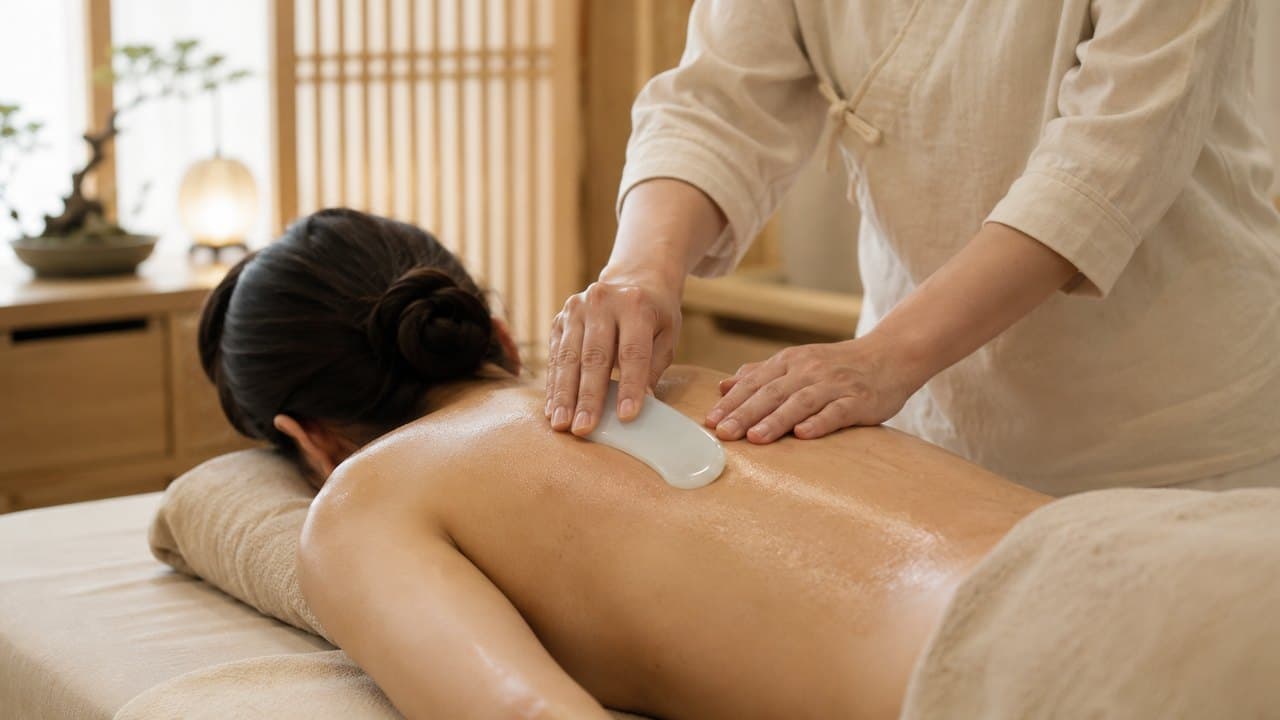
Chronic tension in the back and neck is the most common reason people first find themselves in a TCM physician's room. No accident: work with musculoskeletal pain is the best-studied field of acupuncture worldwide and tuina's home ground.
Below is how the approach works: what the physician does, what a programme consists of, and what to realistically expect. This is educational material, not a prescription: your programme is determined by a physician after diagnosis — see the Traditional Chinese Medicine page.
Why the back 'likes' TCM
Chronic back pain rarely lives only where it hurts. More often it is a chain: overloaded muscles → trigger knots → restricted mobility → compensations in neighbouring zones. Ordinary massage works with the place; TCM works with the chain.
A TCM physician looks at the whole picture: posture, zones of tension along the entire back, sleep, stress, even digestion — everything that shapes muscle tone. Which is why two people with the 'same' lower-back pain will get different programmes.
- Acupuncture — work with trigger zones and the reflex response: see the method page
- Tuina — deep manual work and gentle traction: how a session goes
- Cupping and gua sha — dispersing stagnation, flushing blood to the zone: warmth techniques
- Moxa — deep warming where the tension is of the 'cold' type
How a programme is built
A typical session is a pairing of techniques: needles + tuina, tuina + cups. The physician selects the combination from diagnostic findings and adjusts it session by session, to your response.
A course usually takes several sessions; part of the effect is felt at once (release, warmth, lightness), part accumulates. After the course the physician gives recommendations: exercises, routine, what to do if tension returns.
When TCM is not the first step
An honest frame: with 'red flags' — acute injury, progressing neurological signs (limb weakness, numbness), high fever — modern diagnostics come first, not sessions. In the cluster this is solved in one place: imaging and a specialist consultation, then — by indication — the TCM programme.
That is the advantage of the format: not choosing between 'check' and 'treat by hand', but passing the check-up and the traditional programme in one journey.
Questions
Frequently asked questions
It is individual: some feel notably lighter after the first sessions, others need a course with repetition. The physician will give a realistic plan after diagnosis — and adjust it to the dynamics.
No — and a good TCM physician will never claim so. The methods work as a complement: by indication, after diagnosis, in agreement with your treating physician.
Don't choose in advance: that is the physician's decision from your picture. Most often the techniques are combined within one session — they reinforce each other.
Read next
Useful on this topic
Discuss your situation with a coordinator
Describe your medical goal — we'll advise which documents are needed for a preliminary assessment and what the next steps could be.