
Journal
NK cells in cancer: what the trials showed and how a course runs on Hainan
A patient's own NK cells are added to cancer treatment. What trials showed in lung and liver cancer, which regulatory document applies in Boao Lecheng, and how a course runs.
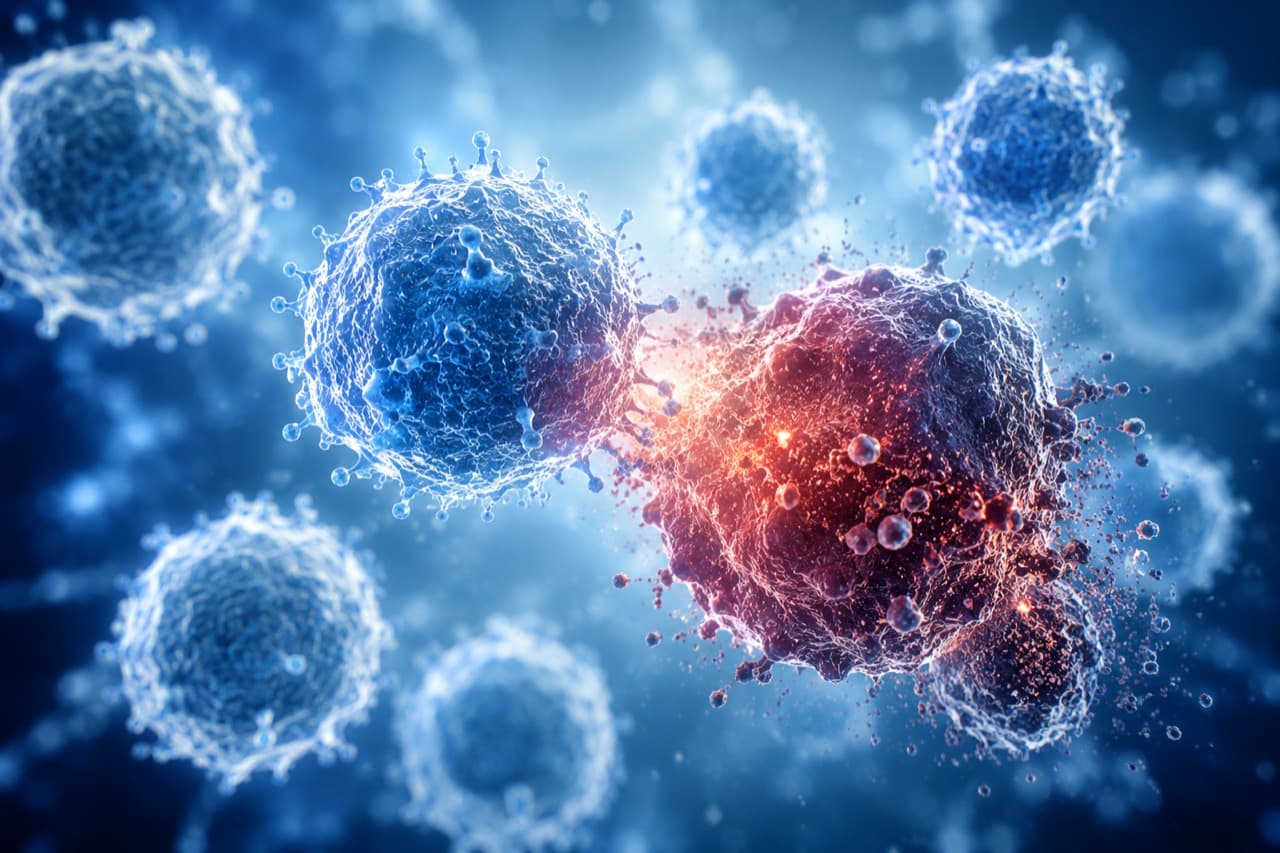
The immune system has cells that do not need to be told who the enemy is. They find a tumour cell and destroy it themselves, with no preparation. These are NK cells, the “natural killers”. In recent years they have become one of the main fields of immuno-oncology: the international registry ClinicalTrials.gov lists more than 950 clinical studies of NK cells, about 200 of them recruiting right now.
In China, the first approvals to use a patient's own NK cells were issued in the Boao Lecheng medical zone on Hainan. Below: what the trials tell us about the method, and how NK therapy works in practice.
What NK cells do
NK cells belong to innate immunity. Most immune cells need to be “trained” on a specific target, which takes days. NK cells act at once: they check every cell they meet and destroy those that have changed — tumour cells and virus-infected cells.
They work in three ways:
- A direct strike. The proteins perforin and granzyme pierce the target cell's membrane and trigger its death.
- Guided action. If a cell is already tagged by an antibody, the NK cell finds it by that tag.
- A signal to the rest. NK cells release cytokines and bring other arms of the immune system into the response.
Eleven years of follow-up: the stronger the NK cells, the less cancer
The central argument for NK cells appeared in The Lancet back in 2000. Japanese researchers measured natural killer activity in 3,625 residents aged over 40 and followed them for 11 years.
The result: people with medium or high activity developed cancer about 40% less often than people with low activity. The relative risks were 0.59 and 0.63.
NK cells weaken with age. Why this happens, and how their strength can be restored in the laboratory, was shown in November 2026 by researchers at the University of Science and Technology of China in Nature Aging. The method is built on exactly this: a patient's own cells are activated and expanded outside the body and then returned.
What the trials showed in cancer
Five studies that physicians rely on today. Country, year and number of patients are given in brackets.
- Lung cancer (China, 2020, 109 patients, randomised). NK cells with the immunotherapy drug pembrolizumab: median survival 15.5 months versus 13.3 on the drug alone, and 18.5 months with repeated courses.
- Lung cancer (Korea, 2022, 18 patients, randomised). Patients' own NK cells with pembrolizumab: tumours responded in 41.7% of patients versus 0%; progression-free time was 6.2 months versus 1.6.
- Liver cancer (Korea, 2022, 11 patients). Patients' own NK cells through the hepatic artery after chemotherapy: tumours responded in 63.6% of patients; median survival was 41.6 months.
- Liver cancer (Korea, 2026, 16 patients, phase IIa of the same method). Tumours responded in 68.75% of patients, with disease control in all.
- Solid tumours (a 2024 pooled analysis: 31 trials, 600 patients). A favourable safety profile; the most common reaction was fatigue.
Why NK cells are combined with immunotherapy drugs
What these studies share: NK cells were added to the main treatment. They do not compete with surgery, chemotherapy or immunotherapy drugs — they reinforce them.
Modern immunotherapy drugs release a “brake” on the immune system that the tumour applies. The same brake, the PD-1 receptor, is present on NK cells. When the drug releases it and there are more active NK cells in the body, both methods work towards one goal. The regulator's approval in Boao Lecheng follows the same logic: a patient's own NK cells alongside immunotherapy drugs.
Safety
NK cells are well tolerated, and the numbers bear this out:
- Your own cells. The body receives its own cells back, so there is no rejection.
- 31 trials, 600 patients. The most common reaction was fatigue.
- Lung cancer, 2022. No dose-limiting toxicity at any dose.
- Every batch is tested. Purity, viability, activity and sterility — before infusion.
- The neighbouring field. In 2020 The New England Journal of Medicine published the first trial of gene-modified NK cells in lymphomas: a response in 8 of 11 patients and none of the severe complications typical of other cell therapies. In 2024 Nature Medicine confirmed this in 37 patients.
How it works in Boao Lecheng
The document. The zone's medical products regulator has issued Boao Worldlight Hospital (博鳌未来医院) its consent to use a patient's own NK cells alongside immunotherapy drugs: No. 乐医药监〔2026〕44号 of 29 April 2026. The document is published openly.
Eight diagnoses. Lung, colorectal, breast, liver, gastric, ovarian, pancreatic and prostate cancer.
How a course runs:
- Review of your records. A physician reads your reports and tells you whether the method suits you. The review is free.
- Work-up at the hospital and a venous blood draw.
- Laboratory. The cells are isolated, activated and expanded over 10–14 days. Each infusion bag holds one to three billion cells.
- Infusion. A drip of about an hour, without hospitalisation.
- Schedule in the regulator's document. Every two weeks, three to six infusions per course. The exact plan is set by the physician.
- Follow-up. Scans, tumour markers and an immunogram — before the course and after.
Sources
What this material draws on
Questions
Frequently asked questions
No — alongside it. The regulator's document says so, and so did every trial: NK cells are added to the treatment prescribed by your oncologist.
Your own. They are obtained from your blood and returned to you, so there is no rejection.
From the blood draw to the first infusion takes 10–14 days. After that, infusions follow every two weeks, three to six per course. We agree the schedule in advance: stay on Hainan for the whole course or fly in for infusion days.
A course of NK therapy is ¥198,000 (about $27,500). The hospital confirms the estimate in writing before you travel, and you pay the hospital directly.
Send your discharge summary, histology and current treatment plan. A physician will tell you whether the method suits your case; the review of your records is free.
Read next
Useful on this topic
Discuss your situation with a coordinator
Describe your medical goal — we'll advise which documents are needed for a preliminary assessment and what the next steps could be.