
Women's health · cellular technologies
Premature ovarian insufficiency: treatment in China (Boao Lecheng)
When the ovaries stop working before 40, hormone therapy remains the standard — and nothing displaces it. But the Boao Lecheng cluster now offers something unavailable in most countries: a conditionally approved cellular technology for POI. Here is an honest account of what it is, and what not to expect from it.
About the condition
What POI is and how it differs from menopause
Premature ovarian insufficiency (POI) is the loss of ovarian function before the age of 40. It shows up as irregular or absent periods, falling oestrogen levels, hot flushes, disturbed sleep and mood, dryness of the mucous membranes, and reduced fertility.
One important difference from ordinary menopause: in POI ovarian function can fluctuate rather than disappear completely and finally. That is why some women retain a chance of spontaneous pregnancy — and it matters when planning.
The cause is not always found. Known ones include genetic factors, autoimmune processes, and the after-effects of chemotherapy, radiotherapy or ovarian surgery. Assessment is needed in any case: the approach follows from the cause.
Why people come
The situations we see most often
If one of these is yours, it is worth establishing the stage and the options.
- Periods stopped before 40
The cycle became irregular or ceased, and menopause is not yet due.
- High FSH, low AMH
Your tests point to a reduced ovarian reserve.
- Menopause-like symptoms
Hot flushes, sweating, disturbed sleep, mood swings, dryness.
- A diagnosis but no plan
You were given the diagnosis and then simply told to “monitor” — and that is not enough.
- After chemotherapy or radiotherapy
Ovarian function suffered during treatment for another condition.
- You are considering cellular technologies
You want to know whether there are indications and what the direction can realistically offer.
Standard care first
What is normally done before anything else
We do not propose replacing proven treatment. On the contrary: without it, any next step loses its meaning.
The foundation of POI care worldwide is hormone replacement, and it addresses more than symptoms:
- Menopausal hormone therapy (MHT) — until the average age of natural menopause: it protects bone, vessels and quality of life
- Bone density monitoring — oestrogen deficiency raises the risk of osteoporosis
- Calcium and vitamin D, with adequate physical activity
- Investigating the cause — hormone profile, karyotype, FMR1 premutation, autoimmune markers, ultrasound
- Fertility planning — a separate conversation with a reproductive specialist; donor programmes where appropriate
- Psychological support — a diagnosis at a young age is hard to take, and that is normal
Cellular technologies do not replace hormone therapy. Abandoning MHT in favour of a cellular programme is a poor decision: without oestrogen, bone and vessels suffer, and that risk is well established.
Where a programme begins
No programme starts without a work-up
Diagnostics come first: they decide whether the method is indicated in your case and to what extent. From here there are two possible next steps.
The regenerative approach
What the cluster additionally considers
On medical grounds — as an addition to standard care, never instead of it.
- An officially approved technology
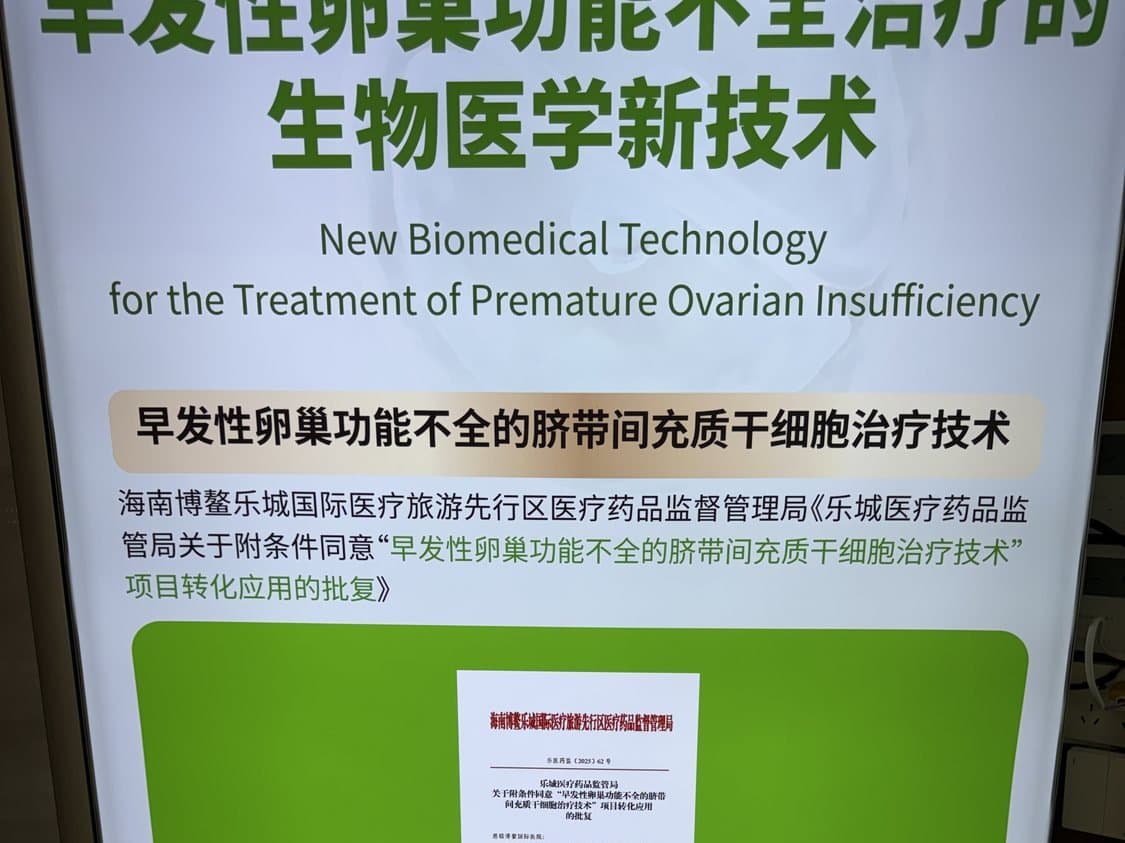
The Boao Lecheng medical products administration has conditionally approved the use of umbilical cord mesenchymal stem cell therapy for POI (document 乐医药监〔2025〕62号). It is among the first such approved technologies in China.
- What is actually used
Umbilical cord mesenchymal stem cells. The aim is to influence the environment within ovarian tissue; this is not “growing new eggs”, and no one promises that.
- Within the legal framework
The clinical application of new biomedical technologies is governed by PRC State Council Order No. 818 and the zone's regulations. Preparations are made in a certified laboratory to GMP standards.
- A new direction — said plainly
Publications on cell therapy for POI are still early, and the approval is conditional, requiring further technical assessment. There are no guarantees of result, and there cannot be.
Methods
Which directions may be considered
What suits your case is determined by a physician after diagnostics.
Cellular and regenerative medicine
How the direction works in the cluster: which cells, from where, and to what protocols.
Cluster hospitals
Where the approval was obtained and how the hospital is matched to the case.
Comprehensive check-up
Hormone profile, bone density and assessment before any programme.
Plainly about the limits
When the regenerative route is not for you
This matters more than any marketing: knowing in advance when the method is not considered.
A cellular programme is not considered here if:
- Natural menopause has arrived on time — that is not POI and does not call for this treatment
- A guaranteed pregnancy is expected — no conscientious clinic promises that; fertility is handled by a reproductive specialist
- No assessment has been done — the programme does not start without a hormone profile and a search for the cause
- There is active cancer or other contraindications to cellular programmes
- Hormone therapy would be dropped in favour of cells — that worsens the outlook for bone and vessels
If your records show no indication, the physician will say so directly. We do not sell a method — we arrange access to a physician's decision and to a technology legally available in this zone.
How it works
From your records to coming home
- 11. Records and tests
You send your hormone profile, ultrasound and records. We translate them for the cluster's physicians.
- 22. Preliminary assessment
The physician reviews the picture and says whether there are grounds to consider the programme. No diagnosis online.
- 33. Assessment on site
Confirming the diagnosis and cause, evaluating contraindications, consultations with specialists.
- 44. The programme
If indicated — a cellular programme to protocol, alongside the prescribed hormone therapy.
- 55. Follow-up
Monitoring to the physician's plan. Care with your gynaecologist at home continues.
Why here
What the Boao Lecheng cluster offers
- The technology is permitted here
The zone's special legal regime allows biomedical technologies unavailable in most countries.
- Controlled production
Cellular preparations are made in a certified laboratory to GMP standards, with every batch checked.
- A team, not one physician
The case is reviewed jointly by gynaecologists and cellular-medicine specialists.
- Confidentiality
A sensitive subject: private support and interpreting at every stage.
Common questions
The essentials
Send your scans — and get a straight answer
A specialist physician in the cluster will look at your stage and say whether the regenerative route is worth considering. The review is free; we do not diagnose online.