
Neurology · Boao Lecheng cluster
Spinal cord injury treatment in China, Hainan
The injury was six months or three years ago: the legs do not obey, there is spasticity and a catheter, and rehabilitation at home comes in short blocks with long gaps. Honestly, up front: nobody here promises you will stand and walk, and cells do not repair a complete transection of the spinal cord. The first step is free: Dr Yang reads your records and says in writing whether a trip makes sense. "You do not need to come" is an answer too.
About the condition
What to rule out before planning a trip
Some situations call for an ambulance or the nearest hospital, not a trip: a sudden pounding headache with a sharp rise in blood pressure and sweating above the level of injury, a pressure sore with fever, a swollen calf or sudden breathlessness, chills with a catheter in place. Stabilise at home first; the trip comes after.
After that, time works quietly. Most neurological recovery happens in the first year, and short courses with long pauses waste it. An unmanaged bladder takes the kidneys away unnoticed, untreated spasticity turns into contractures, every pressure sore postpones training by months. Lost time cannot be won back, and no cells return it. Whether there are grounds at all can be seen from your records, without going anywhere.
Why people come
The situations we see most often
If one of these is yours, it is worth establishing the stage and the options.
- Rehabilitation comes in short blocks
The funded course has ended, the next is a year away, and at home the exercises rest on relatives and internet videos.
- Spasticity and pain take the nights
The legs cramp at night, there is burning below the level of injury, tablets get added one at a time, and nobody has reviewed the regimen as a whole.
- The bladder lives a life of its own
A catheter, infections in a loop, and urodynamics and the kidneys were last checked in hospital after the injury — or never.
- You are offered cells and promised you will stand
You want to know what in that is true and what is sales talk — and to hear it from a physician, not a manager.
- You are looking on someone else's behalf
Often it is a relative who writes, not the patient. A family member can send the records — with the patient's knowledge; a companion on the trip is needed almost always.
Standard care first
What is normally done before anything else
We do not propose replacing proven treatment. On the contrary: without it, any next step loses its meaning.
It starts with standard rehabilitation and prevention of complications — all available where you live. Check what has already been done:
- A stable spine and a closed acute period — surgery, if needed, is done, the neurosurgeon has cleared you for loading, the wound has healed. Without this no programme begins.
- Rehabilitation in stages — inpatient, then a rehabilitation centre, then outpatient; the wheelchair, cushion and orthoses fitted to you through your health system or insurance.
- Bladder and bowel on a plan — intermittent catheterisation instead of an indwelling catheter, urodynamics, a kidney ultrasound once a year, a bowel schedule. This protects the kidneys better than any infusion.
- Spasticity and neuropathic pain — tablets, botulinum toxin for localised spasticity, a baclofen pump for severe spasticity; pain is managed with anticonvulsants and antidepressants. All of this exists in most countries.
- Prevention of complications — pressure sores, thrombosis in the first months, pneumonia in high-level injury, osteoporosis, depression. A properly fitted wheelchair and cushion are treatment too.
Cellular approaches do not replace this path and are considered only within it. If you have had what is owed at home and progress has stalled — send your records: Dr Yang will say whether anything more is worth considering.
Where a programme begins
No programme starts without a work-up
Diagnostics come first: they decide whether the method is indicated in your case and to what extent. From here there are two possible next steps.
The regenerative approach
What the cluster additionally considers
On medical grounds — as an addition to standard care, never instead of it.
- First the complete picture, then the programme
Many discharge summaries end on the day of discharge: the level of injury is there, what is preserved below it is not. In one trip this is assembled: MRI, a segment-by-segment examination, urodynamics and kidneys, spasticity, pain, skin, breathing in high-level injury. A separate question is whether a surgical reason for the stalled progress remains — compression, instability, a cyst inside the cord. Then the neurosurgeon comes first.
- What exists for your diagnosis, and what does not
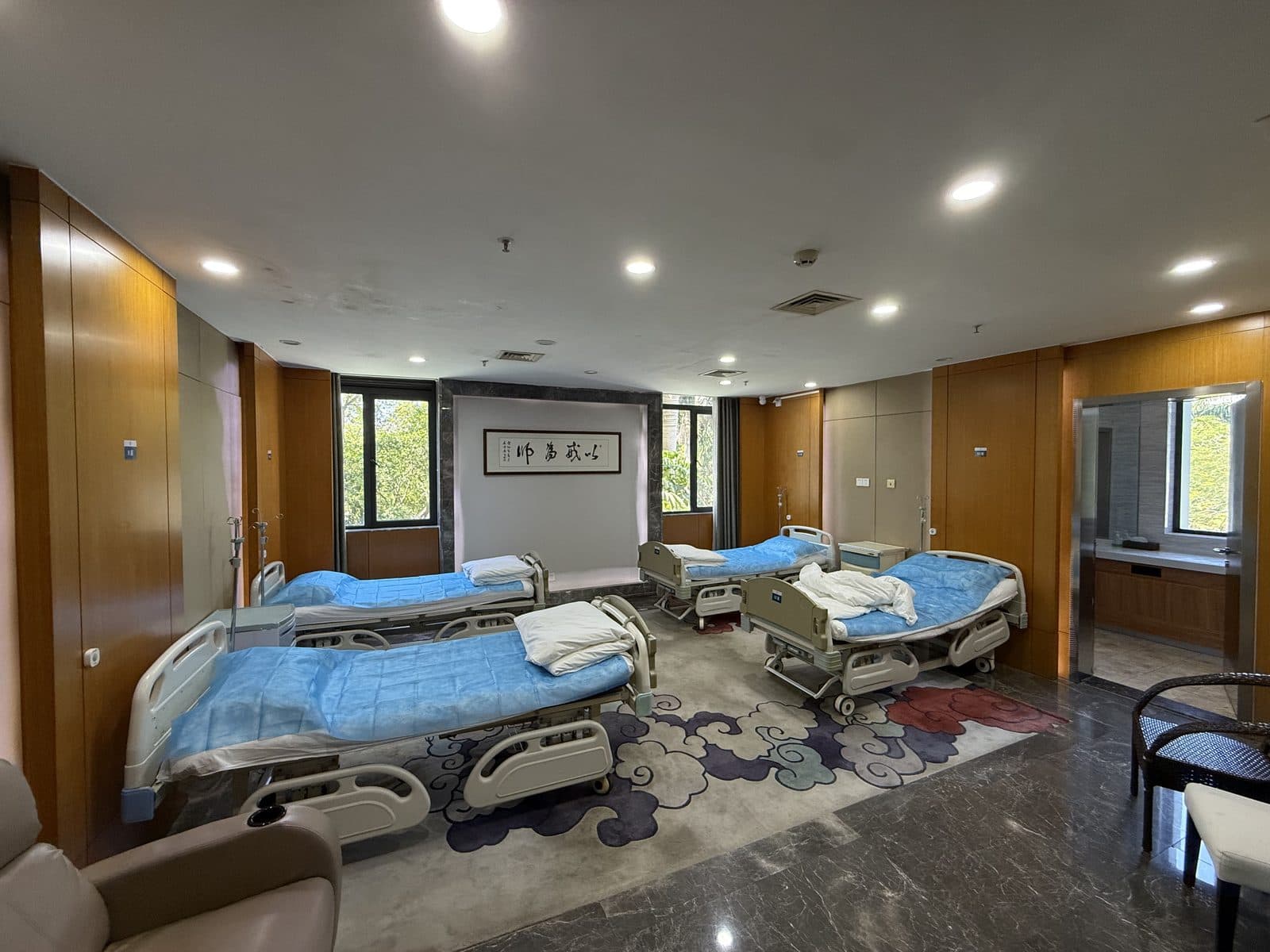
There is daily rehabilitation for several weeks at a stretch, and within it neuroregeneration: cellular and peptide support prescribed by a physicians' panel. What does not exist: a method that repairs a complete anatomical transection — and walking is not promised here. Realistic goals in incomplete injury are part of a function back, less spasticity, a manageable bladder, less pain. Compare not with the rest of China but with what you can get at home: if the same is done in your city, there is no reason to fly.
- How the result is measured
Before the start the numbers are recorded: strength and sensation by segment, spasticity on a scale, independence in daily life — transferring, dressing, getting around — bladder capacity and residual urine, pain on a scale. At the end of the course the same measurements are repeated: you leave with two columns, not a feeling that it is "somewhat better". Failure is when the numbers have not moved, and that is written just as plainly. The same scales and a plan for the coming months go home with you.
Methods
Which directions may be considered
What suits your case is determined by a physician after diagnostics.
Extended check-up
Four days and three nights, around 150 markers. In spinal cord injury it is extended: MRI, urodynamics, kidneys and bone density are costed separately.
Rehabilitation in the cluster
Daily work for several weeks at a stretch: movement, transfers, balance, daily living, the bladder. Scope and duration are set by the physician.
Neuroregeneration within the programme
Cellular and peptide support inside rehabilitation, usually 4–6 weeks, by decision of a physicians' panel. Indicative costs are on the pricing page.
Chinese medicine alongside the course
Master Zhi Ning: sleep, neuropathic pain, spasticity, muscle tone — support agreed with the neurologist. Needles do not repair spinal cord damage.
Plainly about the limits
When the regenerative route is not for you
This matters more than any marketing: knowing in advance when the method is not considered.
There are situations where our answer is: do not come. If you have been told there is no treatment, we do not promise that we have one. Where the records show that a trip would give nothing but lost time and money, we say so plainly:
- The acute period, an unstable spine or an unhealed wound — the first weeks after injury, an unresolved surgical problem, a pressure sore deeper than the skin: that is a hospital and a neurosurgeon at home, not a flight.
- No assessment of fitness to fly — a bed-bound patient, a ventilator, frequent blood pressure surges with headache: whether you fly is decided by your treating physician and the airline, not by us.
- What is owed at home has not been received — the funded rehabilitation stage, a properly fitted wheelchair, urodynamics: that is covered and nearby, and the sensible place to start. Dr Yang's answer can be shown to your own physician.
- You are coming for cells in order to stand — cells do not repair a complete transection of the spinal cord, and with an expectation of "as it was" any programme ends in disappointment. If that is the only goal, it is more honest not to fly.
If the cluster physician says there is no reason to come and a programme can be arranged at home, we pass that on as it stands. The review is free — and a refusal is a result too. We do not sell a method — we organise access to a physician's decision. Send your records · Write on WhatsApp
How it works
From your records to coming home
- 11. You write — we read
Photos of your records by WhatsApp or through the form: we translate, Dr Yang reads and answers in writing. Free. It works without documents at all — describe the situation in your own words.
- 22. The answer: is there any point in coming
In writing, usually within one or two working days. No diagnosis is made online: what goes into the programme and how many weeks it takes is decided by the physician who sees you, after examination in person.
- 33. What is confirmed before the ticket
We ask the hospital about your case: whether it takes it, who leads it, accessibility of the room — and an estimate in writing, before tickets. A course over 30 days needs a visa arranged in advance; shorter stays can use Hainan's visa-free entry with a direct flight to the island.
- 44. The flight and the first days
International flights arrive at Sanya and Haikou, then a road transfer to the cluster; the coordinator meets you and interprets at appointments. The first days are diagnostics: a refusal here is as much a physician's result as a yes.
- 55. Going home
Home with a translated report and the numbers before and after. Complications after return are managed by physicians where you live: neither we nor the cluster hospital can provide care at a distance, and that has to be accepted before the trip.
Why here
What the Boao Lecheng cluster offers
- Dr Yang reads the records himself
A partner physician of the cluster whose medical training was in Russia. Russian-language records he reads in the original; records in other languages are translated before the review. The answer comes from a physician, not a manager.
- You know before buying a ticket
If the drug you need is not in the zone, you learn that before buying a ticket.
- You pay the hospital directly
The hospital issues the bill and you pay its price — no mark-up on medicine. We earn on organisation: support is a separate line in the estimate.
- Care is given by the pilot zone's hospitals
We are not a clinic and we do not treat. Care is delivered by the cluster's state hospitals — they hold the licences and the responsibility; we answer for the organisation and for making sure you are understood. The zone is a pilot: technologies not registered in the rest of China are legally available here.
Common questions
The essentials
Send your scans — and get a straight answer
A specialist physician in the cluster will look at your stage and say whether the regenerative route is worth considering. The review is free; we do not diagnose online.